
A longer home-loan tenure can lower the monthly instalment while increasing the total interest you pay. When comparing Singapore mortgage offers, ask for the same loan amount over the same remaining term first. Otherwise, a smaller monthly figure can hide years of extra repayments.
Extending the term can still be useful when you need breathing room in your budget. The decision is whether that breathing room is worth the additional cost, the slower reduction in your loan balance and the later repayment date. Here is how to compare those trade-offs before accepting an offer.
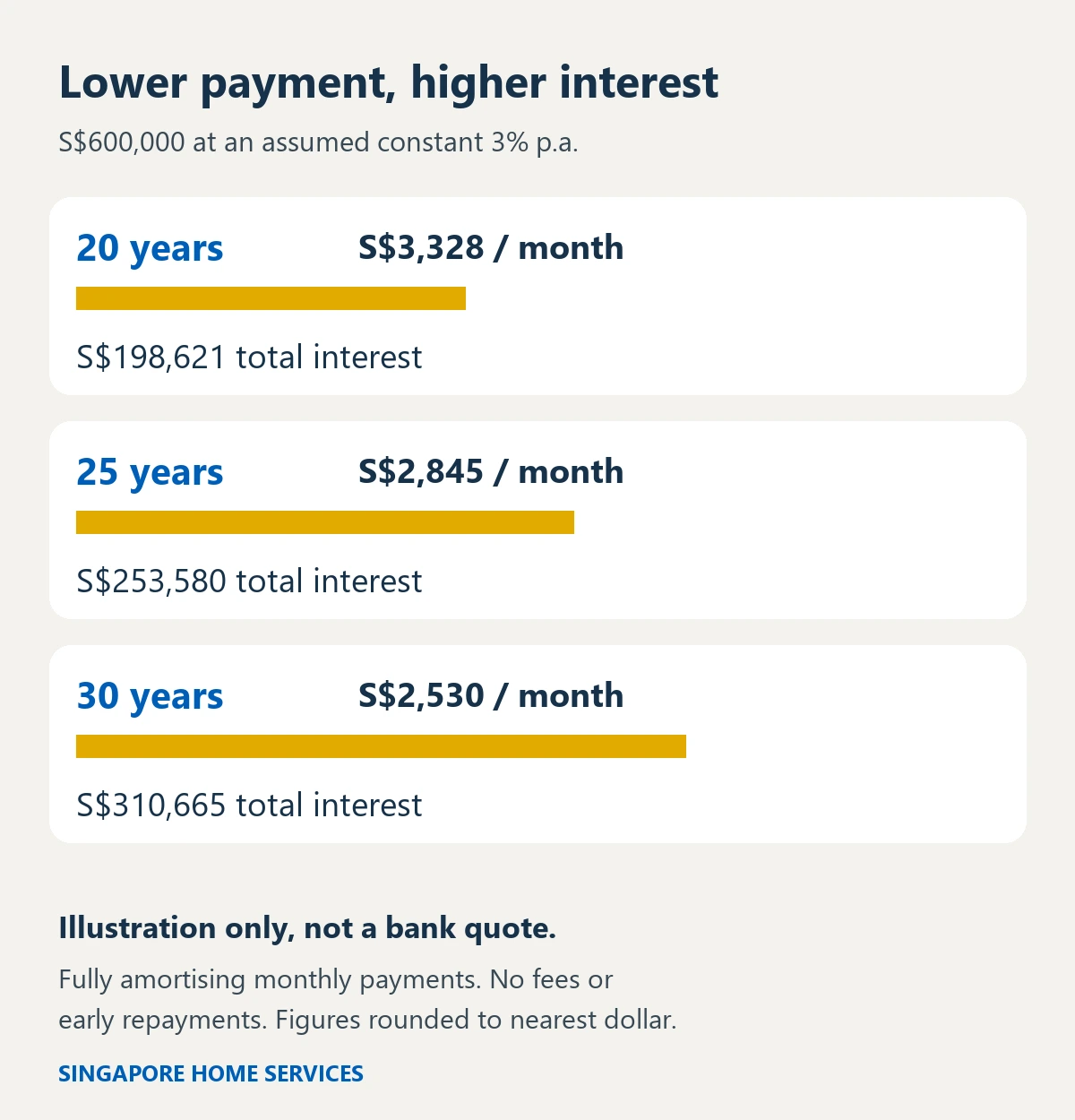
A S$600,000 example: 20, 25 or 30 years
Illustration, not a current bank rate or loan offer. Assume S$600,000 is fully disbursed, the interest rate stays at 3% a year, and equal monthly payments start one month later. There are no fees, missed payments or early repayments. We use monthly interest of 3% ÷ 12. Figures are rounded to the nearest dollar; calculations use unrounded payments throughout.
| Repayment period | Monthly instalment | Interest over full term | Balance after 5 years |
|---|---|---|---|
| 20 years | S$3,328 | S$198,621 | S$481,853 |
| 25 years | S$2,845 | S$253,580 | S$513,033 |
| 30 years | S$2,530 | S$310,665 | S$533,438 |
Moving from 20 to 30 years reduces the instalment by about S$798 a month. If you keep that loan for the full term at the assumed rate, it adds about S$112,044 in interest. After five years, you still owe approximately S$51,586 more under the 30-year schedule.
The monthly reduction is cash-flow relief, not an equivalent saving in borrowing cost. You repay the principal more slowly, so interest continues to accrue on a larger balance for longer. Actual bank calculations, changing rates, payment dates and rounding can produce different figures.
Compare the balance on your likely exit date
If you expect to sell or refinance after five years, the full-term interest figure is not your five-year cost. Compare the payments made during those five years, the remaining balance and any exit costs. A lower instalment may help today, but more principal will still need to be repaid from your sale proceeds or carried into the next loan.
In the illustration, the 20-year schedule involves about S$199,655 of payments during the first five years and S$481,853 still outstanding. The 30-year schedule involves about S$151,777 of payments and S$533,438 outstanding. Adding payments to the outstanding balance gives about S$681,508 versus S$685,216. The difference, approximately S$3,708, is the additional interest incurred over that five-year period, before fees. These sums are a simple cash comparison, not a discounted investment-return calculation.
Check which tenure the bank can actually offer
For bank housing loans, MAS sets maximum tenures of 30 years for HDB flats and 35 years for non-HDB properties. Lower loan-to-value limits apply when the tenure exceeds 25 years for an HDB flat or 30 years for a private property, or when repayment extends beyond age 65. For joint borrowers, MAS uses an income-weighted average age.
Those are regulatory limits, not an entitlement to a particular bank offer. Ask the lender to confirm the permitted term for your transaction, especially for an existing loan or refinancing. Do not assume that moving banks resets every tenure calculation or that a longer term will increase the amount you can borrow. The lender also assesses your circumstances and the property. The table above demonstrates repayment arithmetic; it does not establish eligibility for any of the three tenures.
Separate a lower rate from a longer repayment period
Suppose your present loan has 20 years left, while a competing quote runs for 25 years. Ask for a second quote over 20 years. That comparison shows what the rate change does before you decide whether to extend repayment.
Then compare the 20- and 25-year versions using the same quoted rate assumptions. Include legal and valuation costs, administrative fees, any subsidy clawback and the cost of leaving the current package. Our refinancing break-even guide covers the separate question of whether switching costs are worth paying.
Which trade-off fits your plan?
| Your main concern | What to compare |
|---|---|
| The current instalment leaves too little emergency cash | Test a longer term against a realistic household budget and a higher-rate scenario. Decide how much monthly relief you need. |
| You want to finish repayment before retirement | Work back from your target end date. Compare the required instalment with income you reasonably expect to have then. |
| You expect to sell in a few years | Compare the outstanding balance and all exit costs at that date, not just the full-term interest. |
| You plan to make extra repayments later | Get written confirmation of notice, minimum amounts, charges and whether extra payments reduce the term or the instalment. |
| A new quote advertises a much lower monthly figure | Request an identical remaining-term comparison before attributing the whole reduction to its interest rate. |
Do not treat future overpayments as guaranteed
Taking a longer term and paying extra when you can may sound flexible. It depends on both your finances and the contract. A future bonus may not arrive, and a repayment during a commitment period may attract charges. Ask how the bank applies an extra payment and obtain a revised schedule. Our partial-repayment checklist sets out the questions to ask.
Keep an emergency buffer in your comparison. An aggressive short term can be difficult to sustain if income falls, even when it looks cheaper on paper. Conversely, choose a longer term deliberately: write down what you will do with the monthly breathing room and when you will review the plan.
Questions to send with your quote request
- What are the monthly instalment, maturity date and amortisation schedule at my existing remaining tenure?
- What changes if I choose a longer or shorter term, including the loan amount available and upfront cash required?
- What will I owe after three or five years under each version?
- Which rates apply after any initial fixed or promotional period, and how would a higher rate change my payment?
- What fees, notice periods and conditions apply if I change the term, repay early or refinance?
Compare repayment plans, not just headline instalments
Share your approximate outstanding loan, remaining tenure and preferred repayment end date with Singapore Home Services. We can help compare relevant bank mortgage options. The selected lender determines eligibility, terms and approval.
Sources checked 26 November 2026. Calculations are hypothetical and assume a constant rate; they are not an offer, forecast or eligibility assessment.