
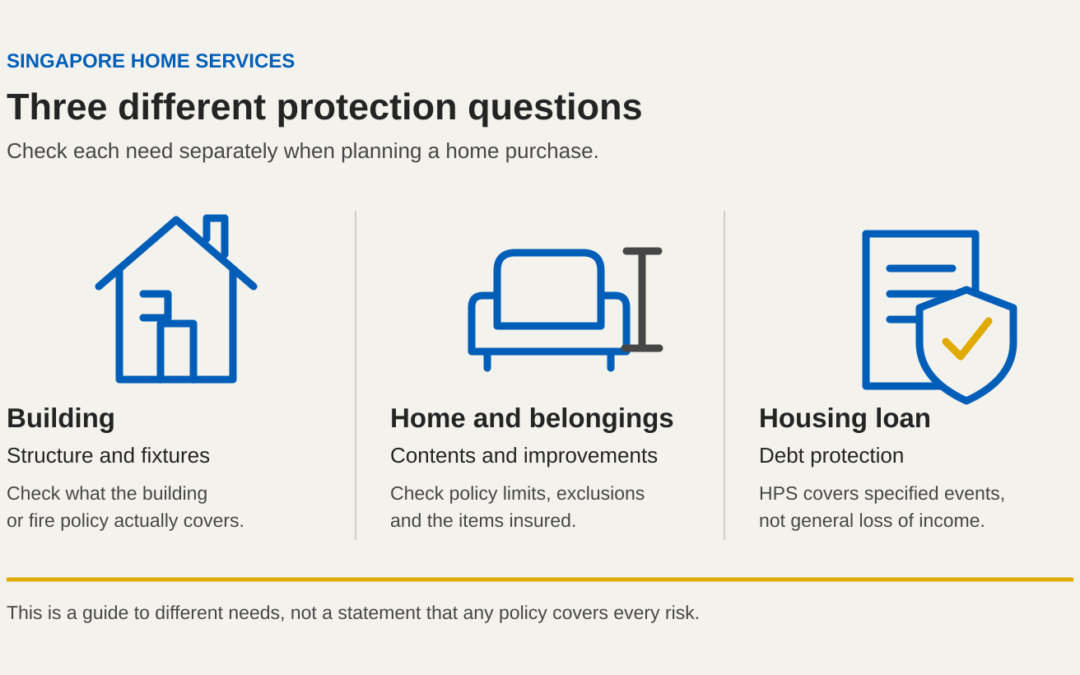
HDB fire insurance helps cover damage to specified parts of your flat. The Home Protection Scheme (HPS) protects against an outstanding housing loan following an insured death, terminal illness or total permanent disability. Private mortgage insurance serves a similar loan-protection purpose, with benefits determined by its contract.
Renovations and belongings need a separate check. Buying one of these policies does not automatically cover all three risks: damage to the building, damage to your possessions, and the death, terminal illness or total permanent disability of an insured borrower.
This guide explains the differences using official information checked on 11 November 2026. It is general information, not a recommendation to buy, replace or cancel a particular policy.
Compare what each policy protects
On a small screen, scroll the table sideways to see every column.
| Protection | Main purpose | What it does not automatically cover | Requirement or decision |
|---|---|---|---|
| HDB Fire Insurance Scheme | Reinstating insured damage to internal structures and HDB-provided fixtures and fittings | Your renovations, furniture and personal belongings; repayment of the loan following a borrower’s death | Required for HDB loans commencing on or after 1 September 1994 while the loan remains outstanding; renew every five years |
| Additional home insurance | Insured damage to renovations, household contents or other benefits specified in the policy | Every cause of loss, every possession or unlimited repair costs | Compare covered events, limits and exclusions |
| CPF Home Protection Scheme | Settling the housing loan up to the insured sum following a covered death, terminal illness or total permanent disability | Repairing the flat or replacing belongings | Required when using CPF for monthly HDB-flat loan instalments, subject to eligibility and approved exemption |
| Private mortgage or suitable life insurance | Financial protection following the events specified in the contract | Property repairs, or automatic approval for HPS exemption | Check benefits, duration, premiums and whether CPF accepts the policy for exemption |
Sources: Etiqa’s HDB fire-insurance information, CPF’s HPS overview and MoneySense’s insurance-needs guide.
HDB fire insurance: check the renovation gap
The compulsory scheme covers specified HDB-provided structures and fixtures. It excludes your renovation work and household contents.
Walk through your flat and separate original fixtures from improvements you paid for. Built-in cabinetry, replacement finishes, appliances and furniture can represent a substantial part of your spending. Ask an insurer how those items are classified and covered rather than assuming “fire insurance” includes everything inside the home.
Etiqa’s current guidance also says an existing home-insurance policy does not remove the compulsory HDB fire-insurance requirement where an outstanding HDB loan applies. See its scheme coverage and FAQs.
For bank financing, ask your lender what property-insurance arrangements its loan requires. Keep that question separate from whether you need HPS. Our HDB loan versus bank loan guide explains the wider financing comparison.
HPS protection for the loan
HPS is mortgage-reducing insurance for HDB flats. It covers death, terminal illness and total permanent disability, subject to the scheme’s terms. Cover runs until age 65 or the housing loan is fully repaid, whichever happens first. CPF explains HPS coverage.
The CPF-payment requirement applies to monthly instalments for an HDB flat, including a bank-financed flat. Paying cash instead does not make HPS compulsory under that requirement, although CPF encourages eligible owners without adequate loan protection to apply. On an accepted claim, HPS settles the outstanding loan directly with HDB or the mortgagee, up to the insured sum. CPF’s eligibility and benefits.
Check the cover share for each owner
Each owner’s cover should at least match their share of the monthly instalments paid using CPF and cash. The household’s total cover must reach at least 100%.
Hypothetical illustration: if one owner pays 60% of each instalment and the other pays 40%, the starting cover shares are 60% and 40%. This is an illustration of repayment shares, not a bank offer or claim estimate. It does not mean either owner’s claim necessarily clears the whole loan. Benefits depend on the insured person’s share.
Owners can choose higher shares, up to 100% each, with higher premiums. Consider affordability and the surviving owner’s circumstances before deciding. CPF’s cover-share guidance.
A medical condition does not give an automatic answer
HPS applications are assessed. From 26 May 2025, CPF expanded coverage to some people with certain less-severe pre-existing conditions at higher premiums. Acceptance is not guaranteed. CPF’s coverage expansion.
Declare health information fully and accurately. If an applicant is ineligible for HPS, CPF says they may still use CPF savings for monthly housing instalments. Confirm the applicable arrangements with CPF. CPF’s eligibility guidance.
Private mortgage insurance and HPS exemption
MoneySense identifies mortgage reducing term assurance as a type of life insurance intended to pay off a mortgage following the borrower’s death. Check the actual contract for other insured events, benefit amounts and duration. MoneySense’s insurance-needs guide.
Suitable private life policies may support an HPS exemption. They must provide adequate protection against death, terminal illness and total permanent disability for the outstanding loan until the loan ends or age 65, whichever is earlier.
CPF accepts certain policy types, including term life and mortgage reducing term assurance, but policy type alone is insufficient. Restrictions apply, including to policies pledged as collateral and non-portable group cover. Fire and home-contents insurance do not qualify. CPF’s exemption criteria.
Ask your insurer to submit the exemption application with current loan details. CPF assesses the application; owning another policy does not itself establish exemption. Do not cancel existing protection on the assumption that approval will follow. CPF’s exemption process.
Your coverage checklist
Before committing, write down:
- Property cover: Which original fixtures, renovations and possessions are insured?
- Claim conditions: What events, exclusions, limits and excesses apply?
- Loan cover: Who is insured, for how much, and until what age?
- Co-owner shares: Do the cover shares reflect repayment responsibilities?
- Existing policies: Would using their benefits to clear the loan leave enough for dependants?
- Affordability: Can you maintain premiums throughout the intended period?
MoneySense recommends assessing debts, dependants, existing savings and ongoing premium affordability when choosing life protection. Understanding life insurance.
Frequently asked questions
Does HPS pay for fire damage?
No. HPS addresses the housing loan after specified insured events affecting the member. Property-damage protection is a separate insurance decision.
Is private mortgage insurance always necessary on top of HPS?
Not automatically. Review existing protection, its duration and your household’s needs. Duplicating a policy name is less useful than identifying an actual coverage gap.
What if my loan continues beyond age 65?
HPS ends at 65 even if the loan continues. Identify that gap early and discuss available protection with an appropriately authorised insurance adviser. Acceptance and terms depend on the insurer.
Can SHS help with the financing decision?
SHS compares mortgage packages across multiple banks. Explore our HDB financing guide and keep insurance selection with CPF, the insurer or an appropriately authorised insurance adviser.
Request a mortgage comparison to review your financing options. Eligibility, pricing and loan approval remain subject to the lender’s assessment.